
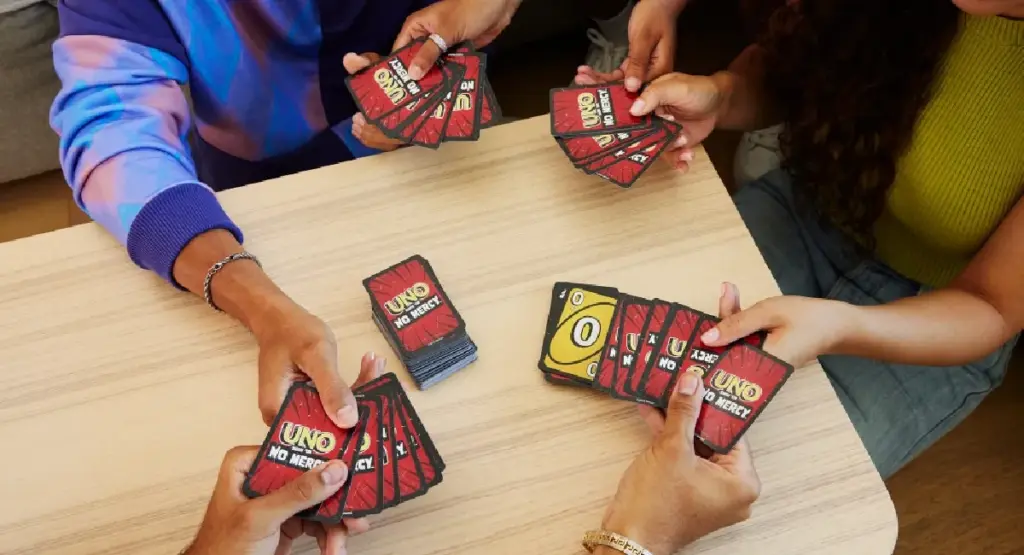
UNO No Mercy is an unofficial fan-made twist on the traditional UNO card game. It takes the familiar rules of colour and number matching and adds a new mechanic called “Mercy,” which can swing a round dramatically. The result is a faster and more unpredictable version of UNO that rewards timing and bold plays.
Introduction to UNO No Mercy

The core of UNO No Mercy is the same as regular UNO: each player needs to use all of their cards before anyone else. What sets this version apart is the introduction of the Mercy rule, which allows players to unleash high-impact card effects when specific conditions are met. This creates more interaction, more opportunities for disruption, and bigger turnarounds.
Game Setup & Components
Setting up UNO No Mercy requires a standard UNO deck. Players can use the full deck of 108 cards, including action cards like Skip, Reverse, Wild, and Draw Four. No additional equipment is needed since the Mercy rule is applied to existing cards rather than requiring unique ones.
Each player starts with seven cards, and the draw pile is created from the rest of the deck. The top card is flipped to start the discard pile, and the first player to the dealer’s left begins. UNO No Mercy is designed to be played in small or larger groups, with the Mercy mechanic scaling according to how many players are involved.
Core Rules & Gameplay Flow
Gameplay follows the standard UNO structure. Players must match the top discard by colour or number, or use action and Wild Cards to change the direction of play. When a player cannot match, they must draw from the pile.
What changes the flow is the possibility of encouraging Mercy. Instead of a simple exchange of one or two cards, a well-timed Mercy action can cause a chain reaction. This mechanic pushes players to think about more than just what is in their own hand, since one move can set off multiple consequences around the table.
The Mercy Mechanic Explained
The Mercy mechanic activates when a player plays a designated action card and chooses to apply a stronger version of its effect. For example, a Draw Two card under Mercy rules might force the next player to draw four instead, while a Reverse could skip multiple players in sequence. Mercy essentially allows cards to be powered up, at the cost of creating more chaos in the round.
Strategy & Tactics
UNO No Mercy places more emphasis on timing than standard UNO. Deciding when to trigger the Mercy effect is often more important than simply holding onto Wilds or Draw Fours. The key is to consider not only your position, but also how many cards others are holding and what actions they might have waiting.
Good strategies include:
- Saving high-impact Mercy plays for when opponents are down to two or three cards.
- Using Mercy defensively when you are holding many cards, to slow others down and buy time.
- Pairing a Mercy action with a Wild Card to change the colour immediately after disruption.
The main challenge is balancing aggression with self-preservation. Overusing Mercy may keep you from finishing your hand quickly, while underusing it removes one of the most powerful aspects of this version.
Advanced Mercy Combos
As players get more comfortable with UNO No Mercy, advanced combinations of cards become important. A common tactic is to chain Mercy actions across multiple turns, setting up one card to make the next more effective. For instance, a player might use a Mercy Reverse to change the flow of play and immediately follow it with a Mercy Draw Two, stacking penalties on the next opponent.
Another strong combination is using Mercy-enhanced Draw Cards just before a Wild Draw Four. This maximises disruption and often leaves an opponent with a full hand. Skilled players also look for opportunities to trap others into drawing excessively, forcing them to cycle through their decks while holding back a small, controlled hand themselves.
Variations
Since UNO No Mercy is a fan-created format, several groups have developed their own interpretations of how the Mercy mechanic works. Some limit Mercy to specific action cards only, while others allow it to apply to all special cards in the deck. There are also house rules where Mercy can be stacked, meaning that if two players in a row use the effect, its power multiplies.
Another variation is limiting the number of times each player can use Mercy in a single round. This prevents the mechanic from being overused and creates more strategic planning. These variations keep the format flexible, allowing groups to adjust the intensity to suit their style of play.
Tips for Competitive UNO No Mercy
In competitive play, reading the table becomes as important as managing your own hand. Watch carefully how other players use their Mercy opportunities, since this can reveal whether they are holding onto specific action cards. Anticipating what others might unleash helps you decide whether to hold your strong cards or play them early.
Another tip is to avoid becoming predictable. If you always use Mercy the first chance you get, other players can adjust their strategy to counter you. By varying when you deploy it, you maintain an element of surprise. Finally, remember that UNO No Mercy is about both disruption and survival: knowing when to stop an opponent matters just as much as planning your own win.
FAQs
What is UNO No Mercy and how does it differ from classic UNO?
UNO No Mercy is a fan-made variation of UNO that introduces the Mercy mechanic. This rule powers up normal action cards, creating stronger effects and more disruptive gameplay.
How does the Mercy mechanic work, and when should I use it?
The Mercy mechanic allows players to boost the effect of specific action cards. For example, a Draw Two under Mercy rules may become a Draw Four, or a Reverse may skip multiple players instead of one. The best time to use it is when an opponent is close to finishing, or when you need to reset the round to your advantage.
What are the best strategies to win at UNO No Mercy?
Strong strategies include saving Mercy for late in the game, pairing it with Wild Cards to control colour, and using it defensively when opponents are nearly out. Timing is crucial, since an early Mercy move can sometimes benefit other players instead of you. Adapting to the table and keeping your plays unpredictable will give you the best chance of success.


